TRUST

SOLUTIONS

YOUR QUESTION HAS AN ANSWER FROM TPS

In order to prepare a benchmarking study that meets the client’s demands there are certain factors that must be considered:

  • correct understanding of the functional profile and risks of each entity participating in the transaction as well as the market context in which they operate;
  • detailed research of databases used for selecting and analyzing the independent companies that meet the criteria of comparability;
  • determining and making the necessary adjustments regarding the comparability;
  • interpretation and use of collected data as well as determination of market value.

The right answer to the question "how much does a benchmarking study cost?"  - we are talking here about a market where quality standards are taken into account and the used databases are approved -  is that the arm's length range is the EUR 2,500 median.

If you do not feel prepared at the moment to conduct a customized benchmarking study for your company, but you would like to find out the profit margins by industry / by type of transactions, please go to the "Benchmarking studies library" section. For a customized benchmarking study please go to one of the "I need a benchmarking study" section, depending on the type of business.

If the business operations are not fully analyzed, you can draw up your own benchamarking study based on data provided by www.studiidebenchmarking.ro.
 

Benchmarking studies are an essential part of both tax planning intra-group transactions and management of tax disputes. But such a study will also be very useful for independent companies. Preparing a benchmarking study has benefits on multiple levels. The most important are presented below.

1. Legal requirements

As required by the existing laws, benchmarking studies are part of a transfer pricing documentation file. Failure to prepare and submit such documentation or submitting an incomplete documentation (e.g. without benchmarking studies) could result in fines, transfer pricing adjustment and late payment penalties.

2. Tax protection

Beyond its mandatory nature, a benchmarking study is a document that can be used to sustain the taxpayer’s position in front of the tax authorities. Basically, you have the opportunity to present to the tax authorities a set of independent party results / prices that are most comparable to your case. This way you avoid the situations when the tax authorities prepare simplified versions of these studies for you that may not take into account your business specifics.

3. Positive impact on business

Benchmarking studies also help you find out which are the prices / profitability in your segment of activity. Thereby, you can use this information in defining your strategic plans or you can keep a close eye on how your competitors are doing.

It is recommended to prepare a benchmarking study annually, not only when tax authorities put pressure on you!

We all know that it’s better to be safe than sorry!

In order to have a benchmarking study done by the book a few key elements must be considered.

(Note: These steps are not mandatory and any other search process that leads to a set of appropriate comparable companies will be accepted. Therefore, choosing another course of action does not mean that the result does not comply with the arm's length principle.)

Step 1: Determination of years to be covered;

Step 2: Broad-based analysis of the taxpayer’s circumstances;

Step 3: Understanding the transactions under examination, based in particular on a functional analysis, in order to choose the tested party (where needed), the most appropriate transfer pricing method to the circumstances of the case, the financial indicator that will be tested and to identify the significant comparability factors that should be taken into account;

Step 4: Review of existing internal comparables, if any;Step 5: Determination of available sources of information on external comparables where such external comparables are needed taking into account their relative reliability;Step 6: Selection of the most appropriate transfer pricing method and, depending on the method, determination of the relevant financial indicator (e.g. determination of the relevant net profit indicator in case of a transactional net margin method);

Step 7: Identification of potential comparables: determining the key characteristics to be met by any uncontrolled transaction in order to be regarded as potentially comparable, based on the relevant factors identified in Step 3 and in accordance with the comparability factors set forth at paragraphs 1.38-1.63 – OECD guidelines;

Step 8: Determination of and making comparability adjustments where appropriate;

Step 9: Interpretation and use of data collected, determination of the arm’s length remuneration.

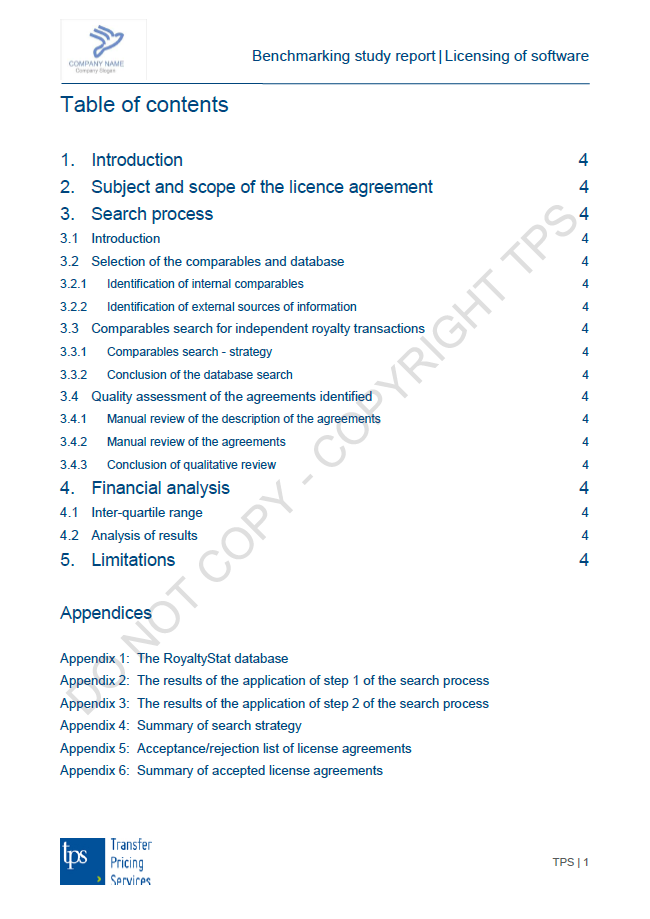
Besides Amadeus / Orbis data bases, which are used to determine profit margins obtained by independent companies, another database which is widely used in practice would be RoyaltyStat used when establishing or testing the market value of the rights of intellectual property royalties licensed between related parties. Given the complexity of such studies, we present below as an example a model of contents that has been successfully tested in practice.

Now, TPS shares its know-how with you! For accessing a template of a benchmarking study just click here.

Nota Bene: A simple copy of the titles will not necessarily gain acceptance of your benchmarking study! The content of the study must be according to the legislation!

Benchmarking studies are the critical part of any transfer pricing documentation file or policy and are mainly used to test the arm's length nature of the related party transactions in preparing a transfer pricing documentation file, set the mark-up attached to the transactions carried out between related parties as part of tax planning exercises and determine the arm's length range deemed to provide an estimate of an arm's length price.

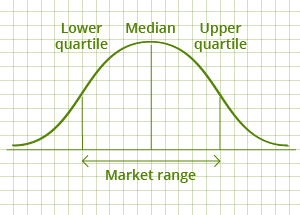
The purpose of benchmarking studies is to determine the general conditions surrounding the transactions conducted by third parties on a given market. Such studies help elicit a range of values, i.e. the so-called arm's length range or mark-up range. Statistically, arm's length range is defined by the lower quartile and upper quartile and is the range of values of price or profit attached to the comparable transactions between comparable unrelated parties.

When a transfer price determined by a taxpayer for a transaction under review (or the profitability derived by taxpayer from such transaction) is not found in the applicable arm's length range, the competent tax authority will determine the arm's length price of the transaction under review using the median value of that arm's length range.