

 for transfer pricing safety










PRACTICAL
- Apple+Ireland vs. Brussels: the iCase of transfer pricing seen through 13 +1 recitals 2020.07.22
- TPS turns 11! Thank you for your trust 2020.03.06
- The very first DAC6-Partner workshop: interactive and instructive! 2020.02.05
- Melting Greenland and the obscure side of the Trump vs. Denmark scandal. A tax perspective! 2019.08.23
- Knowns and unknowns about the nearing transposition of DAC6 (the ”over transparency of intermediaries”) Directive 2019.08.06
- The fiscal battle vowed to be won by Mrs. Ursula von der Leyen, the new EU top executive (with no fanaticism hopefully)! 2019.07.16
- TPSkit (II) - PREXIT 2019.06.06
SOLUTIONS
YOUR QUESTION HAS AN ANSWER FROM TPS
Home
Practice showed us that the rate applicable for the preparation of a transfer pricing documentation file may vary between several thousand EUR (in the case of a company with simple business that does not interact significantly with its related parties) and several tens of thousands EUR (for a very large company involved in highly complex and diverse business activities with its related parties).
There are multiple factors that directly affect the workload required to prepare a transfer pricing documentation file or result in additional overheads (e.g. for the databases used to prepare the comparability / benchmarking studies), which consequently generate an increase in the applicable rate.The most important of such factors include:
- complexity of the business of the group and the local company for which the transfer pricing documentation file is prepared;
- availability of group-wide documentation to be used as basis for the preparation of the local documentation;
- number of the company’s transactions with related entities to be documented;
- transfer pricing methodology used for each category of the company’s transactions with related entities;
- number of comparability / benchmarking studies to be prepared (such studies involve overheads incurred for the use of specialized databases such as Amadeus, RoyaltyStat, LoanConnector or Bloomberg).
Companies with transfer pricing documentation that update it annually will have the advantage of:
- better management of cost operating for their TP file;
- early identification of tax risks as well as taking the necessary precautions in order to minimize them.
Ideally, every company member of a group should have the answer to this question prior and not during the transfer pricing audit.
This section provides information regarding the main reasons for preparing a transfer pricing documentation file:
1. Legal requirements
Failure to prepare and submit such documentation would result in fines, transfer pricing adjustments and late payment penalties. Please find more here.
2. Fiscal protection
You know best which are your company’s functions, risks and assets consequently you can argue the fact that transactions carried with related parties were arm’s length. Having these arguments, the transfer pricing file is the taxpayer’s protection before tax inspectors and transfer pricing adjustments. The file must be updated whenever changes occur within the group or in the relevant market.
3. Management tool
If your business relies mainly on transactions with affiliates, you will certainly want to know if the prices of said transactions are significantly above / below market level.
The benchmarking study, which is the heart of a transfer pricing file will give you the proper signals. Therefore, even though nobody called yet the tax inspector, it would be advisable to update your comparability study at least annually, if not the whole file.
The content of the transfer pricing documentation file
The content of the file generally follows the guidelines included in the Code of Conduct on transfer pricing documentation for associated enterprises in the European Union. The content of the file must be according to the local legislation.
The transfer pricing documentation file should include:
A. Information on the group:
- the organisational, legal and operational structure of the group, including shareholdings, history and financials;
- a general description of the business and business strategy of the group, including changes in the business strategy as compared to the previous tax year;
- a description of and information on the implementation of the transfer pricing methodology within the group, if the case;
- a general description of the transactions between related parties within the EU:
- flows of transactions;
- invoice flows;
- amount of transaction flows;
- a general description of functions performed, risks assumed and a description of changes in functions and risks compared to the previous tax year;
- ownership of intangibles (patents, trademarks, brand names, know-how, etc.) and royalties paid or received;
- a list of advance pricing arrangements entered into by the taxpayer or by other group member companies, except for those issued by the National Agency for Tax Administration.
B. Information on the taxpayer:
- a detailed description of related party transactions:
- flows of transactions;
- invoice flows;
- amount of transaction flows;
- a comparability analysis:
- characteristics of property or services;
- functional analysis (functions performed, risks assumed, fixed assets used etc.);
- contractual terms;
- economic circumstances;
- specific business strategies;
- information on comparable domestic or foreign transactions;
- a list of related parties and permanent establishments involved in such transactions or agreements;
- a description of the transfer pricing method applied and substantiation of the selection criteria;
- a description of other conditions deemed as relevant for the taxpayer.
As a domestic particularity, the order stipulates that benchmarking studies should be firstly carried out at local level and only if no sufficient comparables are found, benchmarking studies can be extended to the regional level.
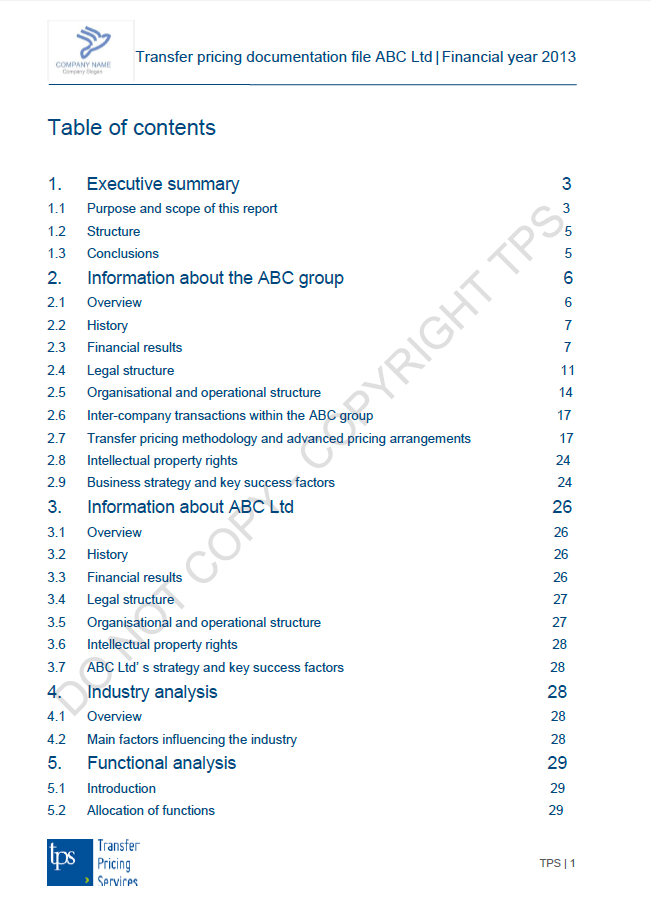
Everyone talks about the transfer pricing documentation file, but not anyone has seen how it looks like. Through our 5 years of experience in transfer pricing, we've prepared this type of report for many clients active in various industries.
Now, TPS shares its know-how with you! For accessing a template of the transfer pricing documentation file just click here.